3D Magnetic Inversion — VectorMag 1.0
Reconstruct the 3D subsurface model from your magnetic anomaly and DEM: susceptibility, magnetization vector (MVI) and confidence (DOI), in an interactive viewer.
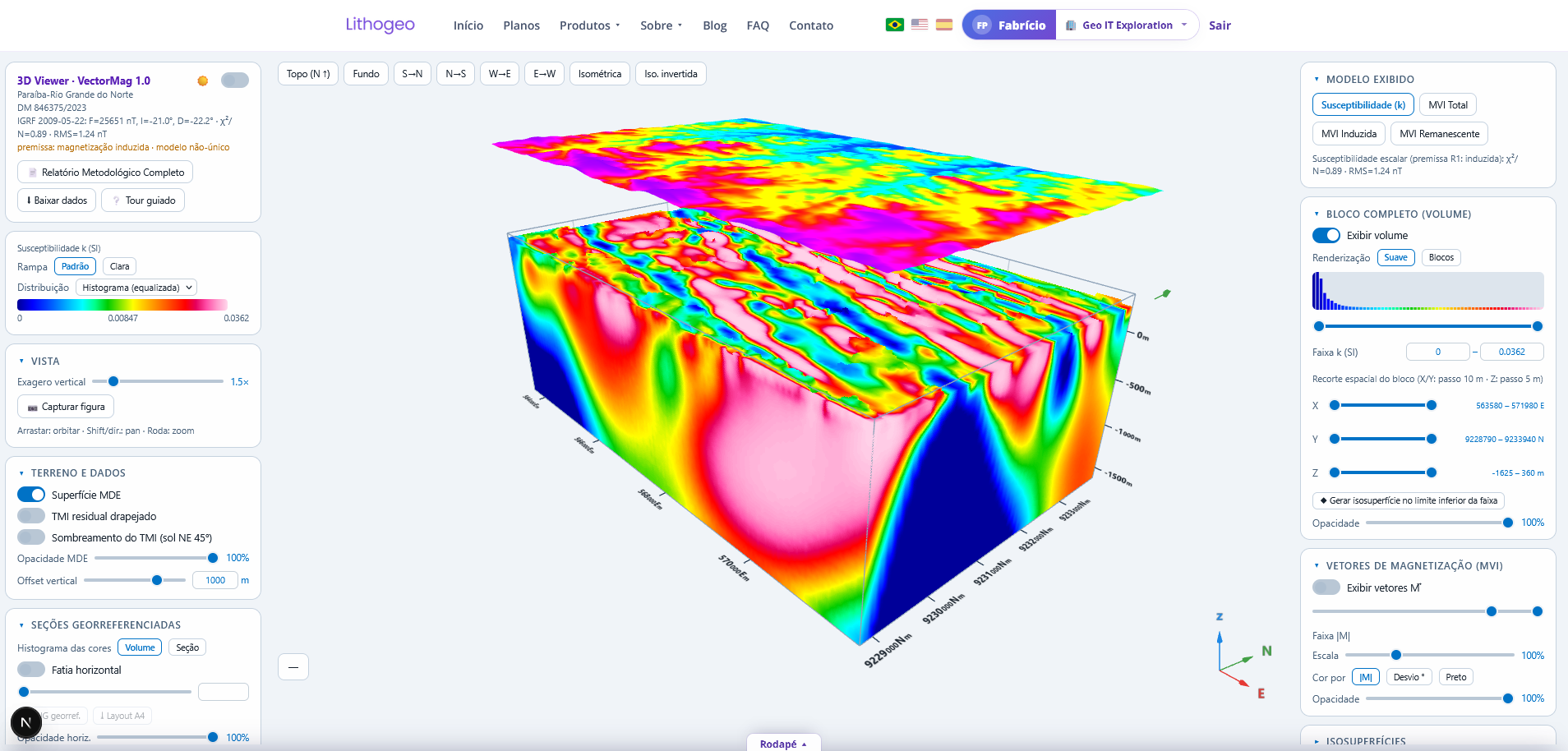
Magnetic susceptibility (k)
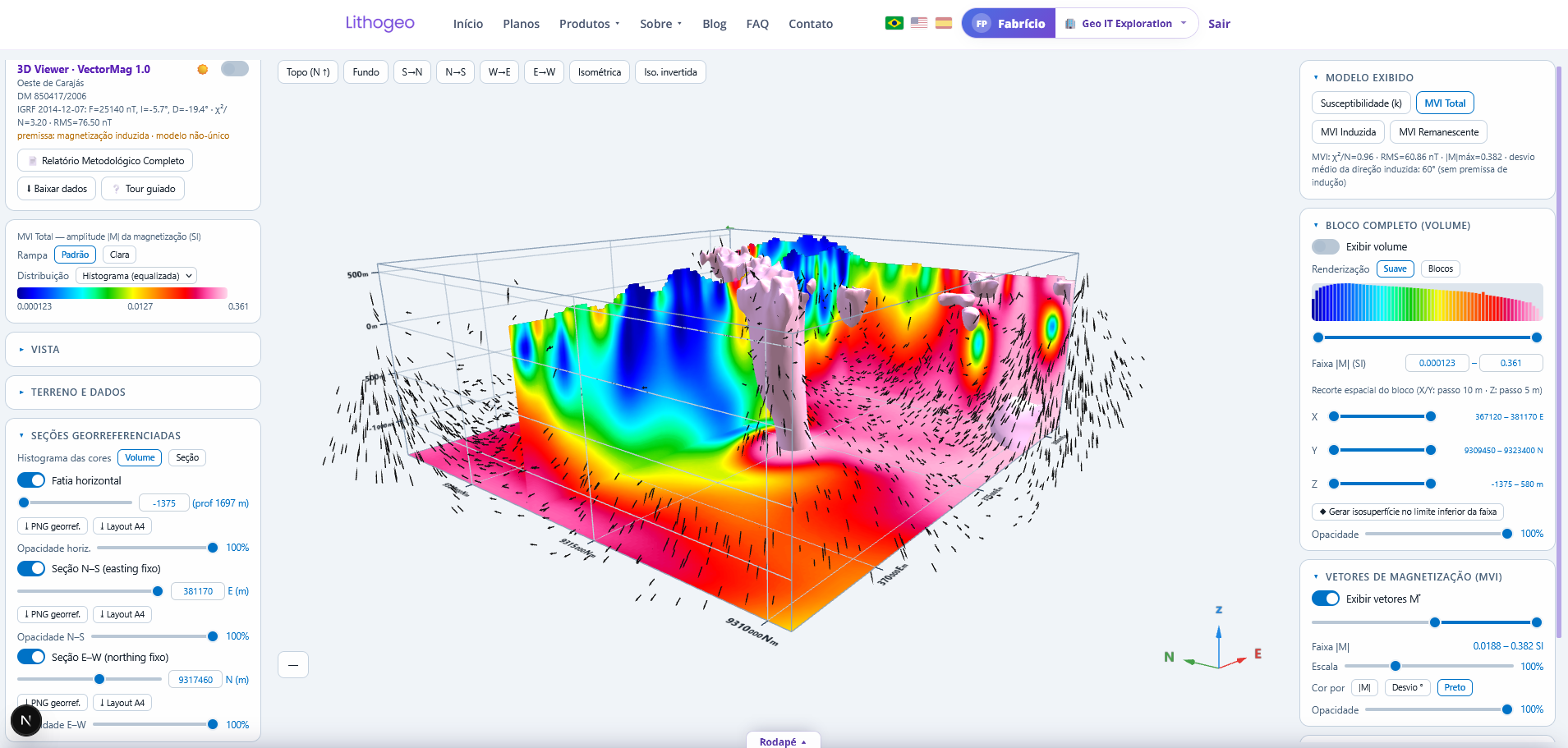
MVI — magnetization vector
DOI — depth of investigation
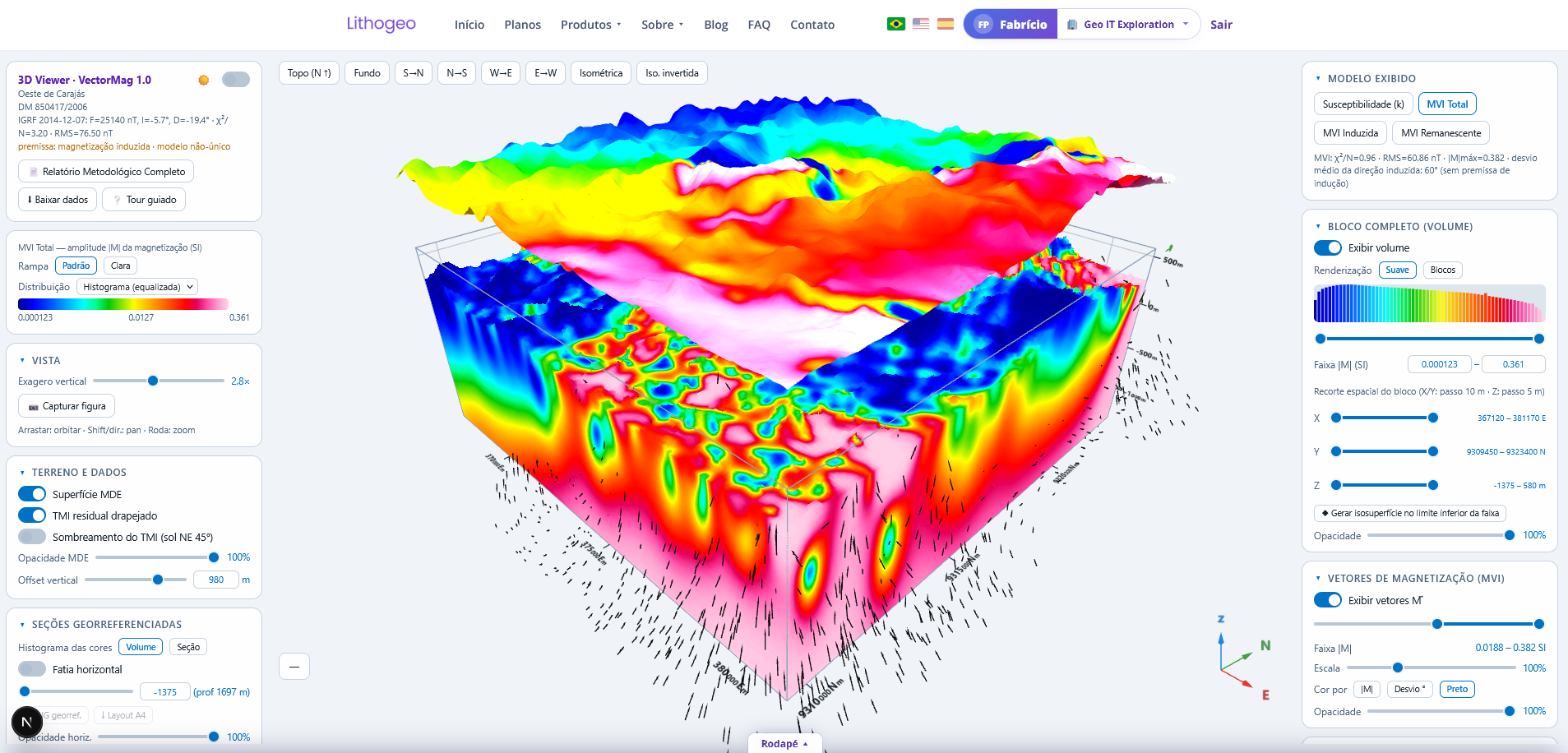
Isosurfaces and slices
3D cell block — hot zones indicate more magnetic rocks (magnetite).
What it is
3D Magnetic Inversion turns your area's magnetic anomaly and terrain into a three-dimensional susceptibility block — the subsurface in 3D, ready to guide your next exploration decision. The foundations are those of a real study: the inverse problem is solved with Tikhonov regularization and a χ²/N ≈ 1 stopping rule — the criterion that stops the fit at the right point, when the model explains the measured data without "inventing" structures the measurement noise cannot support — MVI captures remanence and DOI shows how deep the data actually supports the model. And with zero friction: the inversion starts from your completed Geo Analysis — anomaly, elevation model and survey metadata (IGRF field, flight height and direction) come in automatically, nothing to fill in. One click, and the model opens in the interactive 3D viewer.
- Starts from your Geo Analysis: data and parameters come in by themselves.
- 1 credit = 1 full inversion.
- Uploading your own data arrives in the next version.
What the inversion delivers
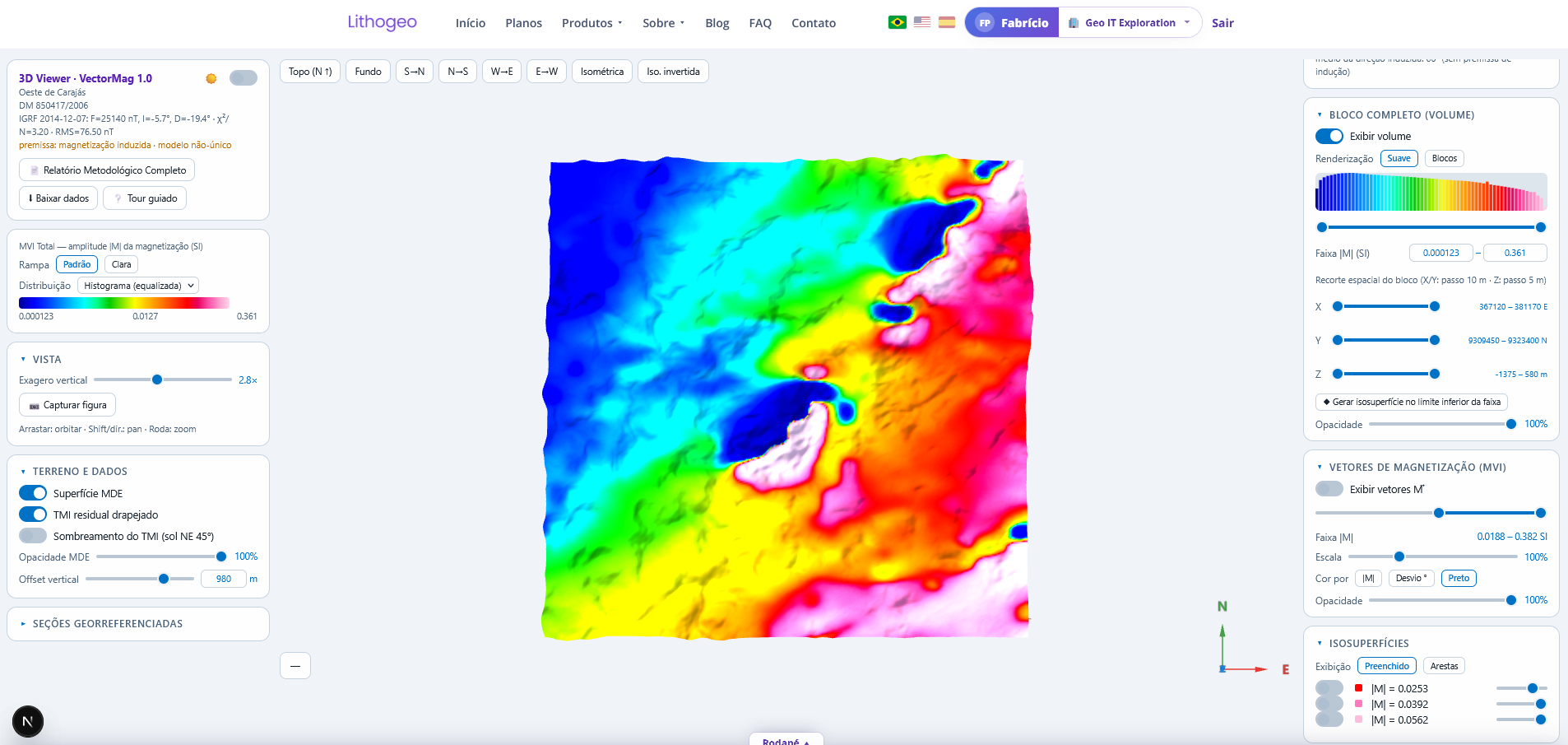
Examples of inversion products, as they appear in the 3D viewer.
Magnetic susceptibility (k)
3D block where hot zones indicate more magnetic rocks (magnetite, mineralized zones).
MVI — magnetization vector
Amplitude |M|, induced component (M∥) and remanent (M⊥) — captures remanence.
DOI — depth of investigation
How far the data actually constrains the model; guides depth interpretation.
3D viewer + report
Interactive isosurfaces, slices and sections, with a full methodological report.
Inversion flow (summary)
Data preparation
Co-registered residual TMI + DEM; noise estimated along flight lines; regional by upward continuation.
Mesh and forward problem
Uniform mesh with per-cell topographic fraction; SimPEG/choclo forward problem.
Tikhonov inversion
χ²/N ≈ 1 stopping and minimum-support focusing; MVI relaxes the induction assumption.
Products and viewer
Susceptibility/MVI, DOI and isosurfaces exported and opened in the viewer.
3D Magnetic Inversion credits
Each credit equals 1 full inversion over an area. Choose the ideal package for your needs.